
Downspouts extensions take roof runoff from the end of the metal downspouts through a pipe which travels underground and exits elsewhere. When these clog, they often have distinct signs. We'll share a couple and also go over some misconceptions or red herrings.
Unknown Exit
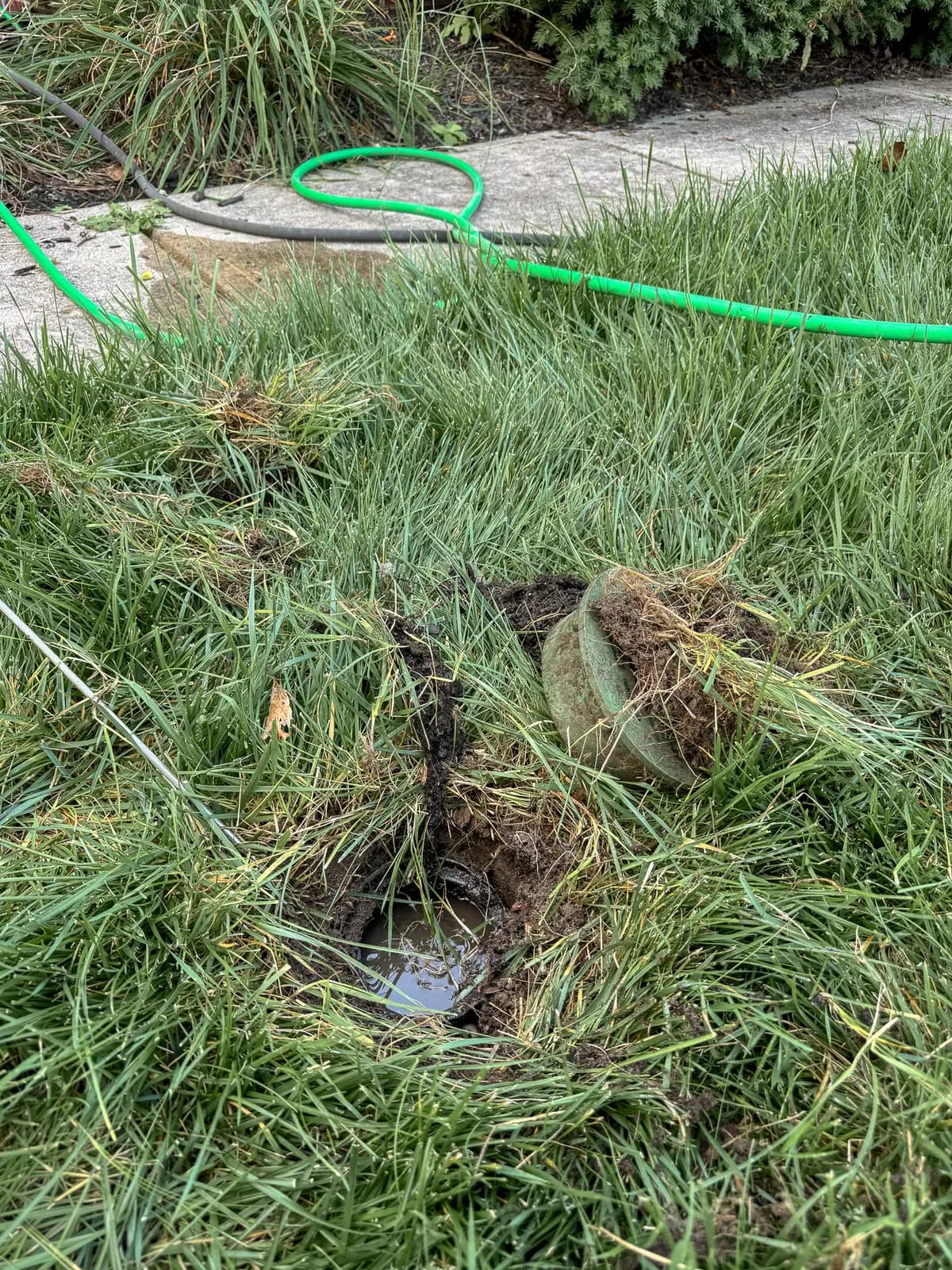
It is exceedingly common that homeowners have no idea where the buried downspout extensions actually lead to. Ideally they should lead, and slope, to an elbow and cap which should be fully exposed and easily spotted when you walk by. Very frequently these caps simply get covered over with sod or dirt, and quickly lost. If the exit is blocked, even if the pipe is clear itself, the line is clogged and water will backflow seeking another path. The exit point must be able to flow freely, and should be upgraded to a proper elbow and opening/closing cap if it doesn't have one.
Circular Washout
When a downspout extension is clogged and it is the reason for an overflow near the house, it will typically look a little bit different than a clogged gutter/downspout elbow higher up will. A clogged extension will usually create a round washout pattern in the mulch/mud right at the base of the downspout. This is from the backflowing water escaping from the gaps between the plastic connector and the end of the downspout.
This is different from a clogged gutter. If the downspout of a gutter is clogged, it will usually back up until enough water spills over the edge in a line parallel to the gutter. A clogged extension can also cause water to travel all the way up so that your gutters overflow even when they are clean, though it's rarer, and you should still see the circular pattern. A clogged gutter alone will not create this round pattern because water isn't getting down to that area due to a clog higher up.
Large Tree Roots Near Line
Most of the time, when these lines are destroyed by roots, it's from internal roots that entered from either end of the line, traveled through the shingle gravel, and grew internally. If you notice that either your exit or any point along the line is right next to a mature tree with large roots that you can see above ground, the kind that are several inches in width, those may very well have crossed over and crushed the pipe. In which case, it will need to be at least cut and relocated. Jetting can't fix this situation, but it can usually identify it.
Misconceptions
The cap area is likely to be soggy after heavy rains. These drains carry the water away from the house and let it drain elsewhere instead of pool up near the home. They do not get rid of it outright. Sometimes they can drain into areas that aren't ideal and make soupy or unpleasant areas due to the runoff but IF THE CAP IS EXPOSED and draining then this is not due to a blockage, but rather a routing issue.
Water will usually not "shoot out" of the end. These lines are gravity fed only and the contents have to travel horizontally some distance. The flow is usually weak; this is precisely why shingle gravel (doesn't float) builds up so easily. Water will usually trickle out or gently pour over the edge of the cap unless it's an extreme downpour; this is normal.
These lines don't have to be watertight. The connection at the house for example where the extension starts should be aligned but doesn't need to be sealed or taped; water shouldn't be built up to that point in a clear line. It is also ok for minor cracks and such to exit on the pipes, especially after the first ~10 feet or so; in fact many lines are perforated beyond this point to help dissipate the water.
In the worst case scenario, these lines are found to be clogged only after a major incident like a flooded basement. These situations can be caused by all sorts of issues but if you find water is entering on the corners only or opposite a downspout on the outside wall in that area, that's a flag worth considering.